PLATFORM COMPARISON

NetSuite vs Wiise: Built for ANZ or built for anywhere? 

NetSuite is made for everywhere — a genuinely capable global platform, built for multi-entity, multi-currency operations at a scale most ANZ mid-market businesses haven't reached. Wiise is made for ANZ — leaner, more specific, and built by people who understand how ANZ businesses actually operate.

Both are genuine cloud ERPs. The difference is what you're carrying underneath the hood, and whether your business actually needs it.

hero-product-frame

IS NETSUITE BUILT FOR YOUR SCALE?

A genuinely powerful platform — built for a bigger job than most ANZ businesses have.

NetSuite spans an enormous range, from small businesses to enterprises with 10,000+ employees. That range is the selling point of NetSuite's architecture. But it’s also where the fit questions start for a $2M–$50M ANZ business.


Reasons Netsuite might not be the best fit:

01 Pricing depends on a sales conversation, not a published number, and the real total only becomes clear well into the process
02 Modules are priced and licensed separately, so the "core" price is rarely the real price
03 ANZ compliance — payroll, STP, local banking — runs through third-party add-ons (like ZonePayroll) rather than the core product
04 The interface and admin overhead assume a dedicated system administrator the business doesn't have
05 Leadership wants confidence they're not paying for global architecture — multi-subsidiary consolidation, multi-currency complexity — the business will never use

NETSUITE VS WIISE AT A GLANCE
The essential differences, side by side

 
NetSuite
Wiise
Built for
✕A global range, from small business to 10,000+ employee enterprise
✓ANZ mid-market businesses, $2M–$50M revenue
Pricing visibility
✕Quote-based, commonly discounted upfront with renewal increases uncapped unless negotiated
✓Published at wiise.com/pricing — one per-user number, no introductory discount reset
ANZ tax, payroll + sector compliance
✕Via third-party add-ons (e.g. ZonePayroll, ANZ Localisation SuiteApp, third party NDIS solutions)
✓Native — BAS/ATO lodgement, Modern Awards, Payday Super and direct NDIA integration built into the core product
AI capability
!NetSuite Next — genuinely real, phased rollout, edition and account limits apply
✓Microsoft Copilot — included in standard licensing
Microsoft 365 integration
✕Separate ecosystem — no native Outlook, Teams or Excel integration
✓Native — Outlook, Teams, Excel, Power Platform out of the box
Running multiple entities/companies
✕Requires the OneWorld edition — priced on top of the base platform, scaling with subsidiary count
✓Multiple companies included — every licensed user can access every company at no extra licence cost
Implementation
✕Typically $75K–$250K*+ and several months for mid-market scope
✓Partner-led, 6–9 months, published starting price


RIGHT-SIZED vs OVERSIZED

Do you need NetSuite's architecture, or NetSuite's price tag?

Independent ERP review sites are candid about this. SoftwareConnect's own verdict describes NetSuite as "generally overkill and prohibitively expensive for smaller businesses," noting the median size of businesses considering it is around 30 employees, despite its range stretching to enterprises with 10,000+ staff.

Meanwhile, actual NetSuite users on G2 describe an interface that's "complex and not very intuitive for new users," with implementations that can be "time-consuming and expensive, particularly when the system needs to be tailored to specific workflows." That's not a competitor's framing, it's independent analysts and the platform's own users describing the fit problem directly.

Running more than one entity is a good example of where that cost shows up. Managing multiple subsidiaries in NetSuite requires the OneWorld edition, a premium tier licensed on top of the base platform, with cost scaling by subsidiary count. Wiise includes multi-company management as standard: every licensed user can access every company in the environment at no extra licence cost.

“
...generally overkill and prohibitively expensive for smaller businesses.
SoftwareConnect
“
...complex and not very intuitive for new users.
NetSuite users on G2

Wiise is built specifically for the $2M–$50M ANZ range: enough platform for real operational complexity — inventory, manufacturing, multi-entity, projects — without the global architecture (or its price tag and admin overhead) that a business this size doesn't need.

WHERE THEY DIVERGE

There's a right time for each platform

Tax and BAS reporting

Netsuite

ANZ-specific tax reporting and document templates are delivered via a separate ANZ Localisation SuiteApp that has to be installed and maintained on top of the core product.

Wiise

Lodges BAS (GST, PAYG withholding, PAYG instalments) directly to the ATO from inside the platform, with GST settlement and reporting handled natively — no separate system or export step to reconcile.

Payroll and modern awards

Netsuite

Australian and New Zealand payroll runs through third-party SuiteApps such as ZonePayroll from Zone & Co.

Wiise

50 pre-built Modern Award interpretations, managed and kept current by Fair Work specialists, applied automatically to raw timesheet data. Payday Super, in effect since 1 July 2026, is handled natively. Payroll sits inside the same ERP as the general ledger, with no separate system to reconcile.

Sector-specific compliance: NDIS

Netsuite

No native NDIS capability. What exists in the NetSuite ecosystem is a third-party partner product (such as CloudNFP, built on top of NetSuite by a NetSuite partner) that layers NDIS compliance on from outside the core platform.


Wiise

The only ERP in Australia with a direct NDIA API integration. Claims are submitted in real time, remittances reconcile automatically, and NDIA catalogue pricing updates itself as the NDIA changes it. A dedicated NDIS chart of accounts, built by KPMG, aligns reporting with NDIA requirements out of the box, and the whole platform is ISO 27001-certified to support audits.

BUILT-IN INTELLIGENCE

AI: Both platforms include it, but it’s sized very differently

Oracle's 2026 push under "NetSuite Next" is significant — natural-language queries (Ask Oracle), autonomous close, AI-powered bank matching, and AI agents (SuiteAgents) that act across the platform, all positioned as included in the licence rather than a paid add-on. This isn't a case of NetSuite lacking AI.

The practical difference is availability and shape. NetSuite's agentic features are in phased rollout through late 2026, with capability varying by account and edition — worth confirming what's actually live before assuming it's there.

Wiise includes Microsoft Copilot in standard licensing today:

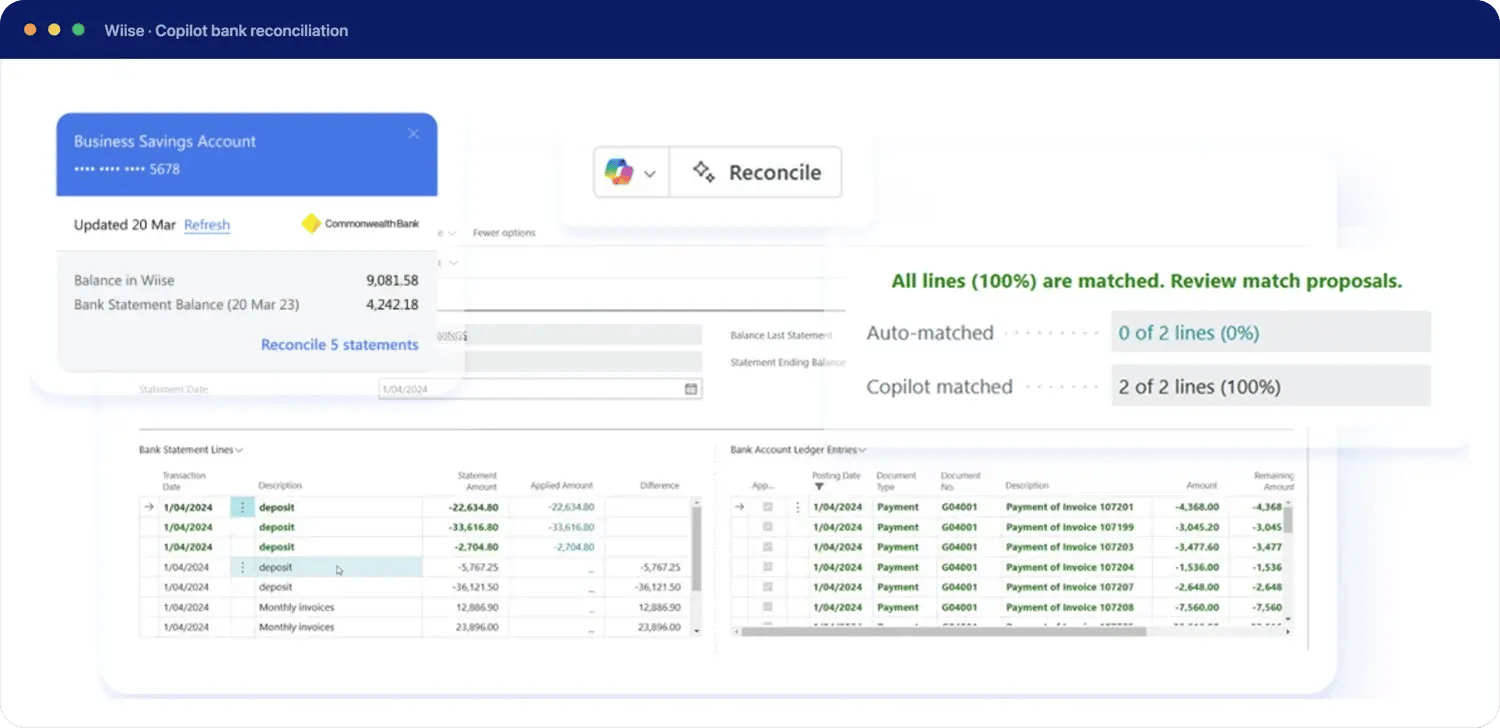
Bank reconciliation Copilot matches statement lines to open invoices and ledger entries automatically
Plain-English questions ask which customers have overdue invoices over $10,000, without building a report
Sales line suggestions Copilot drafts sales order lines based on a customer's order history
Late payment prediction flags receivables likely to be paid late, so credit control can act early

Because Copilot is a Microsoft investment rather than a NetSuite-style in-house build, new capability arrives as Microsoft ships it across Azure, Copilot and the Power Platform — inherited automatically, not built as a separate roadmap item.

Copilot bank reconciliation in Wiise

SCALE THAT MATCHES YOUR BUSINESS

You don't need NetSuite's global architecture to get serious scale

Wiise runs on Microsoft Dynamics 365 Business Central — cloud infrastructure built to handle real transaction volume, without requiring the multi-entity, multi-currency architecture a $2M–$50M ANZ business doesn't need.

Here's a normal day on Wiise, anonymised production telemetry from Microsoft, across live Business Central businesses:
JOURNAL LINES 256,000 posted in a single day
SALES INVOICES 52,500 in a day — 2.6M lines
SALES ORDERS 8,000 created in a single hour

And Microsoft is explicit: these are everyday figures, not the platform's limit. (Source: Microsoft — Service scalability for Business Central online.)


And Microsoft is explicit: these are everyday figures, not the platform's limit.
(Source: Microsoft — Service scalability for Business Central online.)

WORKING IN MICROSOFT 365

Does your ERP work inside the tools your team already uses?

Most ANZ mid-market businesses are already running on Microsoft — email, file storage, reporting, collaboration. The question isn’t whether the ERP can be connected to that environment, but whether it’s actually part of it.

NetSuite

Connected through integration work

NetSuite sits in its own ecosystem, separate from Microsoft 365, so Outlook, Teams, Excel, SharePoint and Power BI all connect through integration work — middleware, connectors, or custom development — rather than as a native part of the platform.

Every one of those connections is something to build, document and maintain, and something that can break when either side updates. For a business without a dedicated system administrator (see “Right-sized vs oversized” above), that’s an ongoing maintenance burden most mid-market businesses aren’t set up to absorb.

Wiise

Built on the same platform

Wiise works natively inside Microsoft 365, because it's built on the same platform rather than connected to it. Open a list in Excel and publish changes straight back with full validation. See a customer's balance and history beside their email in Outlook, and raise a quote without opening Wiise.

Approvals can run through Teams and Power Automate, with live Power BI reports on each user's home screen, and documents can sit in SharePoint alongside the records they relate to. Beyond that, Microsoft AppSource — spanning 19,000+ apps across the Microsoft ecosystem — extends the platform further without custom development.

PRICING + IMPLEMENTATION

How does the real cost compare?

NetSuite prices in layers: a base platform fee (commonly $999–$5,000+/month depending on edition), per-user licensing (roughly $99–$129/user/month for a full user), and separate module pricing on top — none of it published directly by Oracle. Independent implementation guides put mid-market projects at $75,000–$250,000+, typically over 4–6 months for standard scope, longer for multi-subsidiary or heavily customised deployments.

The year one number is also often not the real number. NetSuite's initial contract is commonly discounted — sometimes steeply — to win the deal, with the discount applied only for a fixed initial term.

Independent licensing guides consistently describe the pattern: unless a renewal cap is negotiated into the contract upfront, pricing uplifts at renewal commonly run 8–15%* a year and can run considerably higher once an introductory discount expires and the price resets toward list — real NetSuite customers have reported renewal increases anywhere from 42–150% in a single cycle*.

Contracts typically auto-renew unless cancelled within a defined notice window, and because switching ERPs mid-contract means absorbing a second implementation cost on top of the first, the practical result for many businesses is less a genuine choice and more a reason to accept the increas.

Wiise is priced as a published per-user cloud subscription:

      PLAN
PRICE (AUD/MONTH, EX GST)
INCLUDES
Business
$158 / Full User
Accounting, inventory, warehousing & distribution, CRM, projects & job costing
Premium
$210 / Full User
Everything in Business, plus manufacturing and service management
Team Member
$23.50 / user
Limited-access licence for occasional users
Device
$84 / device
Shared-device licensing (e.g. warehouse terminals)


Microsoft Copilot is included in standard licensing with no separate AI module or usage fee.

Independent research found Wiise customers see:

172% ROI
18% productivity improvement
$245k in labour cost savings on average
Read the full report →

WHICH FITS YOUR BUSINESS?
There's a right time for each platform

When businesses choose NetSuite:

They're already running ten or more subsidiaries across multiple countries, requiring complex multi-entity financial consolidation
Multiple currencies are core to daily operations, not just occasional foreign transactions
Their subscription or SaaS revenue model needs complex recognition (ASC 606 / AASB 15) that goes beyond what an embedded Business Central add-on (like Binary Stream's Subscription Billing Suite) can cover
Global eCommerce is central to the business, and needs NetSuite's native commerce platform
The business has reached genuinely enterprise scale — 500+ users — where a mid-market platform becomes a real limitation, not just a growth target
They have the internal resourcing and budget to manage and maintain a specialist, highly customised implementation long-term

When businesses choose Wiise

✓Operations are ANZ-focused across a small number of countries, or growing into new markets gradually rather than running complex consolidation today
✓Leadership wants published, predictable per-user pricing instead of a quote-based process
✓The business wants Microsoft 365 and Copilot AI natively, not as a separate ecosystem to integrate
✓ANZ payroll and Modern Award compliance need to be built in, not bolted on through add-ons
✓The priority is a platform sized — and priced — for where the business actually is, not where a global enterprise might be


MOVING FROM NETSUITE

What does migrating from NetSuite to Wiise involve?

Migration complexity depends on how many NetSuite modules and customisations are in use. Talking it through usually covers:

1 Which NetSuite modules, SuiteApps and customisations are currently in use
2 What data needs to move — customers, suppliers, inventory, transaction history
3 Which connected systems or add-ons (like third-party payroll) need to be replaced or integrated
4 Whether existing processes should be replicated as-is or redesigned around Wiise's native capability
5 Reporting, approvals and audit trail requirements in the new system

SEE HOW WIISE WORKS

Get the ERP that's sized just right for your business

Talk to the Wiise team about what a move from NetSuite would look like.

  •  

FAQs

What's the difference between Wiise and NetSuite?

NetSuite is a global cloud ERP built to serve businesses from small companies to enterprises with 10,000+ employees, with strength in multi-entity, multi-currency and multi-subsidiary consolidation. Wiise is built specifically for ANZ mid-market businesses ($2M–$50M revenue) on Microsoft Dynamics 365 Business Central, with native Microsoft 365 integration and ANZ compliance built in rather than added on.

Is NetSuite too expensive for a small or mid-sized business?

For many ANZ mid-market businesses, yes — independent reviews commonly describe NetSuite as "overkill and prohibitively expensive for smaller businesses," with pricing that's quote-based and modular across the base platform, users and add-on modules. Wiise publishes per-user pricing directly, starting at $158 AUD/month for a Full User on the Business plan.

Does NetSuite handle Australian payroll and compliance natively?

Not entirely. NetSuite's Australian payroll is typically delivered through third-party SuiteApps such as ZonePayroll, and ANZ-specific tax reporting requires installing a separate ANZ Localisation SuiteApp. Wiise includes Modern Award payroll, STP and Payday Super compliance natively, without a separate add-on.

Does NetSuite include AI at no extra cost?

Oracle positions its 2026 "NetSuite Next" AI capabilities — including Ask Oracle and AI agents — as included in standard licensing, similar to Wiise's approach with Microsoft Copilot. The practical difference is availability: NetSuite's agentic AI features are in phased rollout through late 2026, with capability varying by account and edition, while Wiise's Copilot features are available today.

Is Wiise a replacement for NetSuite?

For ANZ-focused mid-market businesses without a near-term need for multi-country, multi-currency consolidation, yes. Businesses evaluating NetSuite often find its global architecture, pricing and implementation scope built for a larger or more internationally complex operation than they actually run.