




.svg)


Freight surcharges around the globe are moving fast, and not in the direction businesses were hoping for.
Following the Australian Government's three-month halving of the diesel fuel excise, freight carriers have been forced to recalibrate their surcharge models almost overnight. As of early April 2026:
-
Team Global Express is charging a fuel levy of 45.66% (Palletised Express), effective 6 April 2026
- Freightlinks is charging up to 65% (Hi Trans Express), effective 31 March 2026
- Road transport in generally is seeing fuel levies of 30–53% across carriers
At these rates, these aren't footnotes on an invoice anymore – a fuel levy can represent a significant portion of your total freight cost, and if your ERP isn't handling them accurately and automatically, you're either hurting your bottom line or creating admin headaches for your team. One point worth clarifying: carriers refer to these charges as "fuel levies," whereas when these costs are passed along, they become "fuel surcharges," which is what's reflected on customer invoices.
And it's not just freight: businesses that rely on contractors, ad hoc transport, or that run their own fleet, are feeling the squeeze on labour and resource costs too. Fuel-driven cost increases flow through to contractor rates, vehicle running costs and delivery schedules – and without visibility into job costing and resource allocation, it becomes significantly more difficult to quote accurately, plan resources, and protect margins.
It's a pressure point we're hearing from clients across the board. Cameron O'Neill, owner of Aker Advantage, says
"As a small business, absorbing these freight cost increases while staying competitive is genuinely hard. But what helps me is having real visibility — I know what everything is costing me, so even if I can't control the market, I can control how I respond to it."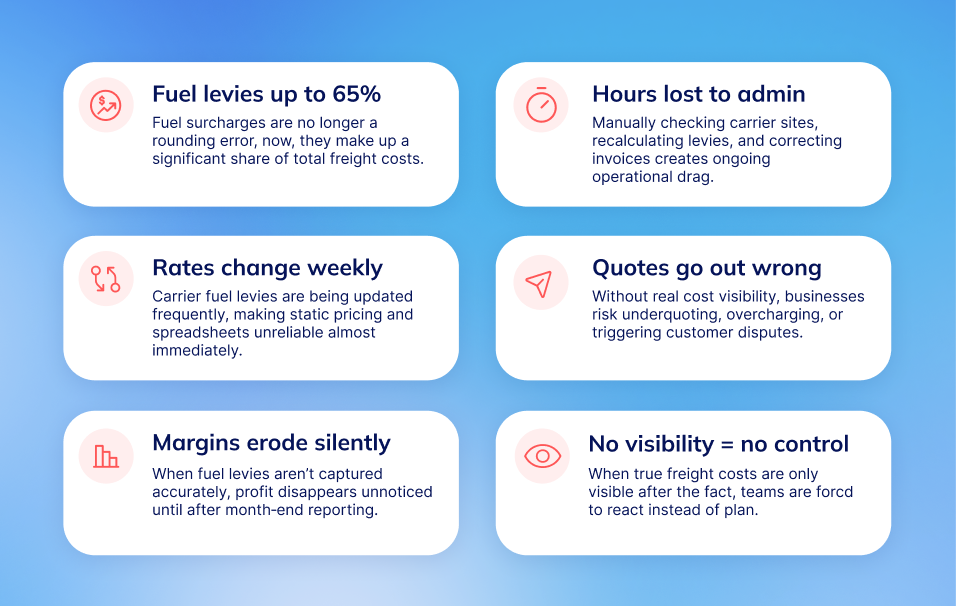
The good news for businesses running Wiise? You’ve got multiple tools available to manage fuel levies with precision, consistency and minimal manual effort. Keep reading to explore some practical approaches customers can use right now.
Two approaches to managing surcharges within Wiise
Wiise offers multiple methods for managing levies and surcharges to help you stay on the front foot with pricing adjustments – so you can protect your margins, despite market shifts.
- Item charges
- Dynamic ship (via InsightWorks)
Keep reading for an overview of the two approaches, as well as a detailed breakdown of each one.
At a glance: Two approaches using Wiise
|
Feature |
Method 1 – Item Charges (Purchase + Sales) |
Method 2 – Dynamic Ship by Insight Works |
|
Automatic calculation |
✓ Can be templated |
✓ Real-time, live rates |
|
Tiered/break amounts |
Via manual setup |
✓ Carrier-driven |
|
Flat rate supported |
✓ Yes |
✓ Yes |
|
Assigned to customer/vendor |
✓ Via vendor/item setup |
✓ Per carrier profile |
|
Visible line on document |
✓ Separate charge line |
✓ As shipment cost |
|
Easy rate update |
✓ Update charge item |
✓ Live from carrier |
|
Selective application |
By purchase or sales order |
By carrier / service |
|
Inventory cost impact |
✓ Yes — updates COGS |
Optional |
|
Wiise Landed Cost compatible |
✓ Yes — native |
✓ Via Item Charges |
Method 1: Item charges, the complete freight levy toolkit
Item Charges in Wiise give you a flexible, end-to-end way to manage fuel levies, whether you're capturing the true cost of inbound freight in your inventory, or passing outbound surcharges through to your customers with full transparency. Let's look at both sides.
Capturing inbound fuel levies — True landed cost
For businesses receiving stock where carriers issue a separate invoice for freight and fuel levies, Wiise's Item Charges feature — enhanced by the Wiise Landed Cost module — is the most powerful tool available.
When goods arrive via a Purchase Order, you create an Item Charge (for example, "Freight Fuel Levy") and apply it against the original Purchase Receipt. Then, Wiise distributes the cost across the received items using your preferred apportionment method:
- By Quantity
- By Amount
- By Weight
- By Volume
- Equally
- By Duty (for customs-specific charges)
Critically, this automatically adjusts your inventory valuation so that your stock reflects its true landed cost, not just the purchase price. When those items are sold, the fuel levy flows through accurately to your COGS, giving you an accurate picture of your margins.
The Wiise Landed Cost module goes further, allowing you to:
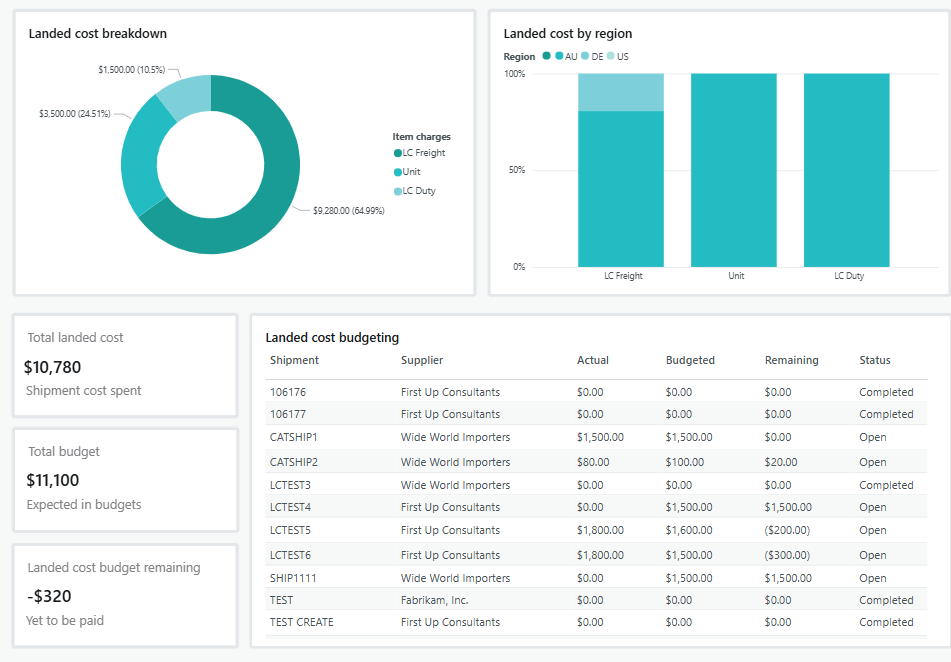
- Budget for freight, duty and cartage on a Landed Cost Receipt, even before the carrier invoice arrives
- Group multiple Purchase Orders under a single Bill of Lading or container reference
- Apply additional apportionment methods across multiple shipment lines
- Maintain visibility of the last Landed Cost Per Item for informed pricing and margin decisions
- Apply fuel levies after receiving, processing and shipping goods, allowing continued operations while maintaining accurate COGS and in turn, margins
So what's that actually mean for you? With the Landed Cost Module in your toolkit, every pricing decision, customer quote and purchase order is grounded in what your stock actually cost to land — not what you estimated before the carrier invoice arrived. In a market where freight levies are moving as fast as they are right now, that's the difference between margins you can rely on and margins you're constantly second-guessing.
Without that visibility, businesses run into a slew of complications: freight invoices arrive days or weeks after goods are received, costs get logged separately (if at all) and by the time anyone can work out actual landed costs, stock has already been priced, quoted, or sold. Some businesses absorb the difference quietly, others chase it through manual spreadsheet reconciliations at month-end. Either way, someone is carrying a cost they didn't plan for – and most likely can't afford.
This method is best suited for importers and wholesale/distribution businesses that receive goods from carriers who invoice fuel levies separately, and need those costs accurately reflected in inventory valuation and margin reporting.
In the real world: Taipan
Taipan, a Brisbane-based distributor, was managing landed costs — freight, duty, and cartage — manually across spreadsheets and disconnected systems. True product costs were only available after month-end, which made pricing decisions slow and margin visibility unreliable.
After implementing Wiise's Landed Cost module, their finance team could enter freight invoices (fuel levies included) and apportion costs to inventory in one place, in real time. As Linda Farrell, Administrative CEO, puts it, "We now have full visibility with live data and can make decisions faster."
For a distribution business dealing with fuel surcharges that shift week to week, that kind of immediacy matters.
Passing fuel levies to customers — Transparent outbound charges
That same Item Charges framework also handles the other side of the equation: charging your customers for fuel levies on outbound shipments.
You create a dedicated "Fuel Surcharge" charge item (for example, "FUEL-LEVY") and configure it with the appropriate General Product Posting Group to direct revenue to the correct G/L account. When added to a Sales Order, it will appear as a clean, separate line on the customer's invoice, not buried in a freight total.
How it works in practice:
- Your sales team raises a Sales Order for a customer in Sydney
- A "FUEL-LEVY" charge line is added, applying the current carrier levy rate (say, 45.66%) against the freight amount
- The customer receives an invoice with a clearly itemised fuel surcharge line — no ambiguity, no disputes
- When Team Global Express updates their FSC next week, you update the default price on the FUEL-LEVY charge item once, so all new orders automatically reflect the new rate
One important distinction: unlike the purchase-side Item Charge, the sales-side version does not adjust inventory cost — it posts as a revenue line to your P&L. This is the correct behaviour for an outbound freight surcharge.
This method is best suited for businesses that apply fuel levies selectively to customers, want a transparent itemised line on the customer's invoice, and need to update rates centrally as carriers adjust their levies.
Method 2: Dynamic Ship by Insight Works – Live carrier rates with zero manual effort
For businesses managing multiple carriers and high shipment volumes, manually tracking weekly FSC updates from Team Global Express, Freightlinks, and others just isn't sustainable. Dynamic Ship by Insight Works solves this by pulling live carrier rates, including fuel surcharges included, directly within Wiise at the point of despatch.
How Dynamic Ship works:
Here's a realistic scenario: your warehouse team in Melbourne is processing 40 outbound shipments for the day. Orders are going to customers across Victoria, Queensland, and Western Australia in a mix of parcels and palletised freight.
Without Dynamic Ship, your dispatcher would need to check each carrier's website for current fuel levy rates, manually calculate the surcharge for each shipment, and enter a charge line on each sales order. With levies changing weekly and multiple carriers in play, the chance of using a stale rate — or missing a charge entirely — is high. And in the current climate, that’s a mistake you really can’t afford.
With Dynamic Ship:
- The dispatcher opens the shipment in Wiise and selects the despatch action
- Dynamic Ship connects in real time to your configured carriers — including Australia Post, DHL, and regional providers — and returns live rates with current fuel surcharges already embedded
- The dispatcher selects the preferred carrier and service level, comparing rates on screen
- Dynamic Ship generates the carrier-approved shipping label directly from Wiise, no separate portal, no re-keying
- The customer automatically receives a branded tracking page with real-time updates
With this method, the fuel levy is never a separate calculation – it's already built into the rate. And because Dynamic Ship pulls live from the carrier's API, it reflects Team Global Express's latest weekly FSC update automatically, not the rate from last month's printout.
What Dynamic Ship includes
-
400+ carrier integrations — parcel, LTL, and FTL, including major Australian domestic and international providers
- Real-time rate shopping — compare live rates across carriers at the point of despatch
- Automated label generation — print carrier-approved labels directly from Wiise
- Intelligent package management — auto-packing, barcode scanning, and shipment grouping
- Address validation — built-in verification to prevent costly re-shipments
- Branded tracking pages — real-time updates delivered under your brand
- LTL and FTL support — Bill of Lading documentation and carrier coordination for complex freight

New in 2026 — 2Ship partnership
In March 2026, Insight Works announced a strategic partnership with 2Ship, connecting Dynamic Ship to 2Ship's platform of 775+ carriers and 95+ system integrations. For Australian businesses managing both domestic and international freight, this significantly expands the carrier options accessible directly inside Wiise.
Combining Dynamic Ship with item charges
For the most complete solution, use Dynamic Ship to quote and process the outbound shipment (live fuel levies included), then use an Item Charge to record the actual freight cost against the sales order. This gives you full visibility of your true outbound freight cost per shipment in your P&L and in your profitability dashboards in Wiise.
This method is best suited for multi-carrier businesses, high-volume shippers, and businesses that want live, carrier-calculated rates with zero manual surcharge management.
A Wiise approach for Australian businesses
Given the current volatility in Australian fuel levies — road transport charges have moved from around 14% in early 2026 to more than 50% in some cases by late March, a layered approach gives you the best coverage:
- Wiise Landed Cost + Item Charges (Purchases) — Capture inbound freight fuel levies accurately in your inventory valuation. Know your true landed cost per SKU before you set a price.
- Dynamic Ship (Outbound) — Let carriers quote live rates at the point of despatch, with current fuel surcharges already embedded. No manual rate management required.
- Sales Item Charges (Customer Billing) — Pass fuel levies through to customers with a clearly itemised line on their invoice. Update rates in one place when carriers change their levies.
- Wiise Actionable Insights / Landed Cost Dashboard — Monitor freight costs, landed cost trends, and margin impact across accounting periods.
Get in touch
If you're currently managing fuel levies manually, or want to understand how Wiise can automate your freight surcharge handling end-to-end, we'd love to help. Both approaches can be configured and tailored to your specific carrier mix, customer agreements, and margin requirements.
Reach out to our team today and we'll walk you through the right combination for your business.