




.svg)


There's a question that doesn't get asked enough when a software platform announces an AI partnership: is this AI being added to the product, or is it already part of it?
It might sound like a subtle distinction, but in practice, it really does shape everything: how reliably the features work, how quickly new capabilities arrive, whether "AI-powered" means something is live today or coming "later this year” (We’ve all heard that one), and whether you actually get value from the AI, or if it’s just ticking a box.
MYOB recently announced a five-year strategic partnership with Microsoft to co-build AI across its platform. Although they made the announcement several weeks ago, we still haven't heard much in the way of details about what practical or tangible enhancements it will bring. Still, it's a significant move, and the ambition behind it is genuine. But for anyone currently evaluating ERP software, it's worth understanding exactly where each platform sits on that spectrum, and what that means for your business right now.
Two very different starting points
MYOB Acumatica is a well-established platform that has built its own independent technology stack. It does what it does well. But when it comes to AI, it's starting from an integration point: signing a new partnership, co-building with Microsoft engineers, establishing an AI Academy, and planning to roll out customer-facing features "later in 2026."
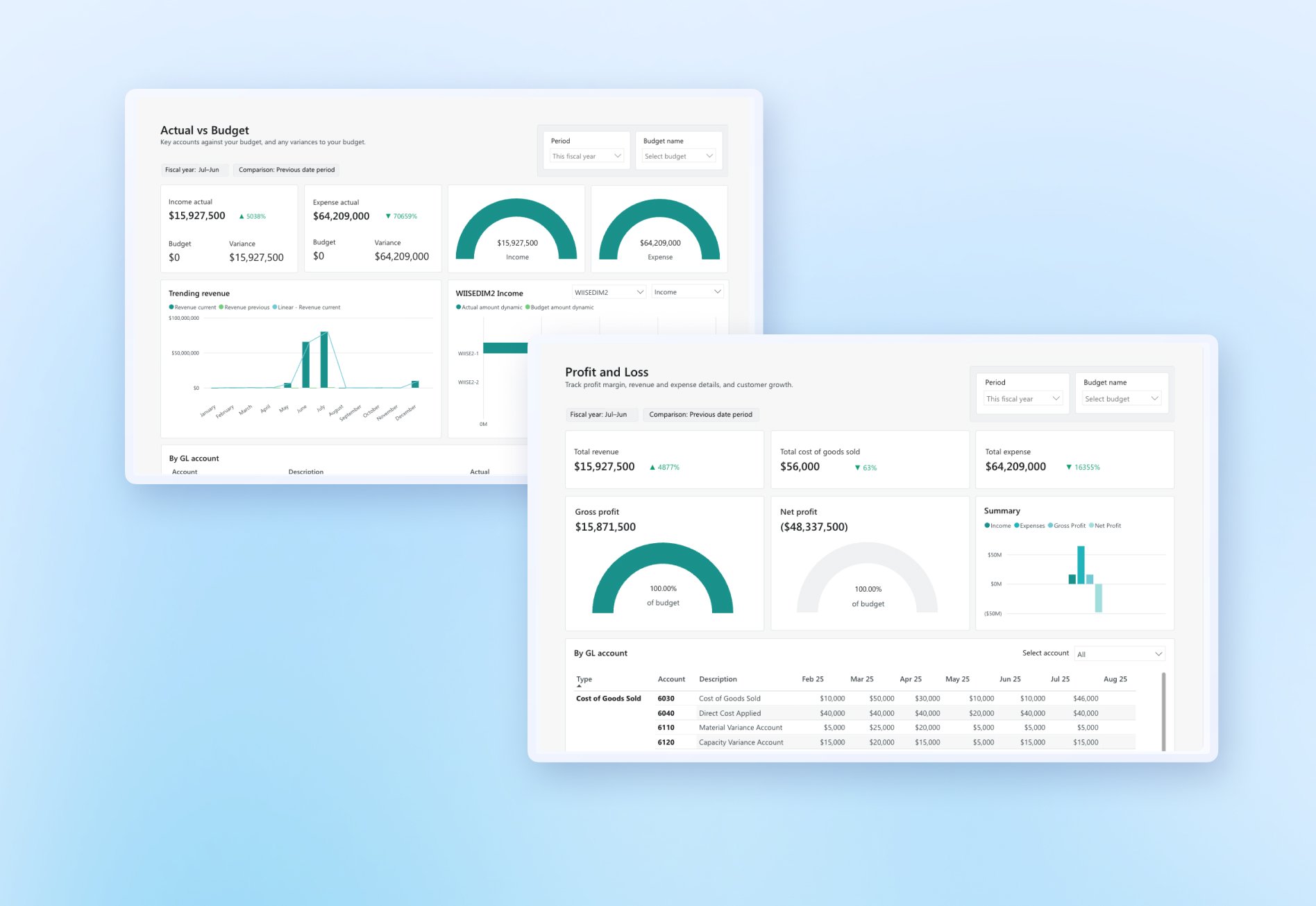
Wiise was built fundamentally differently. We're built directly on Microsoft Dynamics 365 Business Central, which means Microsoft's AI infrastructure isn't something we're connecting to – it’s baked into the platform we run on. Copilot, AI agents, Microsoft 365 integrations, Azure security — these aren't features added on top, they're part of the underlying architecture.
When Microsoft ships new AI capabilities to Business Central, they arrive in Wiise. Not via a partnership roadmap. Not after a co-development sprint. They're just there.
What MYOB is building toward
The ambition behind MYOB’s announcement is real. The partnership will leverage some serious Microsoft tooling:
- Microsoft Foundry — to deploy customer-facing agentic AI at scale
- Copilot Studio — to build and deploy internal AI agents
- Agent 365 — for governance of AI in an agentic environment
- Late payment prediction — Wiise uses AI to identify which customers are likely to pay late, so you can manage cash flow before it becomes a problem
- Inventory demand forecasting — AI-driven forecasting helps you hold the right stock levels without over-ordering or running short
- AI-assisted product descriptions — import a product catalogue and let AI generate descriptions, categories and marketing copy based on attributes and your preferred tone
For MYOB customers, the promise is intelligent agents that can forecast cash flow, guide compliance readiness and surface business insights. For their mid-market Acumatica platform, the roadmap includes natural language queries and AI-assisted document processing.
These are genuinely useful capabilities. The honest caveat is that the first jointly developed features are expected later in 2026 — and a five-year partnership doesn't come with guaranteed delivery milestones. Again, it's a co-investment in a direction, not a product launch.
What Wiise customers have today
By contrast, Wiise customers already have access to the Microsoft AI capabilities that MYOB is in the process of building toward, including late payment prediction, inventory demand forecasting and AI-assisted product descriptions
They’re part of the underlying Business Central platform on which Wiise sits. Not as a bolt-on or a beta — as standard, enterprise-grade functionality built into the platform.
Copilot is embedded across the Wiise experience as an intelligent assistant. It helps reconcile bank accounts in seconds, matching individual transactions and lump-sum payments, teaching itself to recognise patterns over time and post to the right GL accounts automatically. It analyses financial, inventory and customer data in response to plain-language questions. It surfaces what you're looking for — invoices, stock levels, customer details — without you having to navigate to find it.
AI agents go a step further. Wiise's Sales Order Agent, for example, can securely access incoming emails, check live inventory levels and lead times, and automatically create sales orders — without a human in the loop for every transaction. That kind of automation is available now, for businesses managing high-volume order flows.
Other AI capabilities already live in the platform include:
And remember, all of this runs within your Microsoft environment – your data doesn't leave to train public AI models. Security, encryption and compliance standards are inherited from Microsoft's cloud infrastructure, the same stack that enterprises around the world rely on.
The "built-on" vs "connected-to" distinction
There's a useful analogy here. Think about the difference between a car with navigation built into the operating system versus one with a phone mount stuck to the dashboard. From the outside, both give you directions. But one responds instantly, updates automatically, integrates with your speed and fuel data, and gets better every time the software does. The other depends on your phone battery, loses connection in a tunnel, and needs a new mount every time the hardware changes.
The end result might look the same on a demo. But in daily use, the gap compounds.
That's roughly the position Wiise and MYOB are in with respect to Microsoft AI.
MYOB is doing the right thing by investing in this direction. The Microsoft tools they're adopting are excellent, and dedicated co-engineering support should accelerate what's possible. But the process of building those integrations — connecting external systems, establishing data flows, testing for reliability — takes time. And every new AI capability Microsoft releases needs to go through that process again.
For Wiise customers, that cycle doesn't exist in the same way: new Microsoft AI features land in Business Central, and they're available. The platform evolves in place.
What this means if you're evaluating your options
If you're a CFO or operations leader currently running on MYOB — particularly on the core SME product rather than Acumatica — it's worth asking your rep for specifics on the AI roadmap: what's available now, what's coming in 2026, and what the timeline actually looks like in practice.
If you're evaluating ERP or business management software for the first time, or considering a move, the AI question deserves more than a line on the feature checklist.
Buying an ERP isn't like buying a point solution you can swap out in twelve months. It's a core platform your entire business will run on — finance, operations, inventory, compliance — and the realistic horizon for that decision is five to ten years, often longer. That's a long time in technology, and an enormous amount of time with respect to AI specifically. Think about where AI sat just three years ago compared to today. The rate of change is only accelerating.
Right now, AI is a competitive advantage. In a few years, it will be infrastructure, something your business depends on as fundamentally as your accounting ledger or your payroll system. Choosing a platform that treats AI as an add-on isn't just a functionality risk today; it's a platform-fit risk for the business you'll be running in 2028, 2030, and beyond. Every time the technology moves forward, a bolted-on approach means another integration project, another lag, another gap between what's possible and what your system actually delivers.
The platforms that will serve you best aren't just the ones with the strongest AI features today — they're the ones architected so that AI improvements arrive as a matter of course, not as a project.
That's the case we'd make for Wiise. Not because we've signed a big partnership announcement, but because we've been running on Microsoft's platform — and benefiting from its AI investment — for years.
Want to see Microsoft AI in action inside Wiise? Explore what's available today on our Microsoft AI page, or get in touch to see a live demo.
